Languages & voices

Global Voice to Text in 100+ Languages

Build multilingual voice experiences with Privocio's speech-to-text API. Transcribe audio across 100 supported languages with one developer-friendly platform.

When I build voice features, I do not want them to work only for English users. Real products are global. Users speak different languages, switch between accents, record audio in noisy environments, and expect voice technology to simply understand them. That is why global voice to text matters.

Global voice to text illustration with sound wave and supported language flags around a microphone

Supported speech-to-text languages

Search and browse all 100 supported languages. Each entry includes the language name, Whisper language code, and STT support status.

100 of 100 languages

Supported languages for STT with flag, language name, Whisper code, and capability status
FlagLanguageCodeSTT
Afrikaans flagAfrikaansafSupported
Albanian flagAlbaniansqSupported
Amharic flagAmharicamSupported
Arabic flagArabicarSupported
Armenian flagArmenianhySupported
Assamese flagAssameseasSupported
Azerbaijani flagAzerbaijaniazSupported
Bashkir flagBashkirbaSupported
Basque flagBasqueeuSupported
Belarusian flagBelarusianbeSupported
Bengali flagBengalibnSupported
Bosnian flagBosnianbsSupported
Breton flagBretonbrSupported
Bulgarian flagBulgarianbgSupported
Cantonese flagCantoneseyueSupported
Catalan flagCatalancaSupported
Chinese flagChinesezhSupported
Croatian flagCroatianhrSupported
Czech flagCzechcsSupported
Danish flagDanishdaSupported
Dutch flagDutchnlSupported
English flagEnglishenSupported
Estonian flagEstonianetSupported
Faroese flagFaroesefoSupported
Finnish flagFinnishfiSupported
French flagFrenchfrSupported
Galician flagGalicianglSupported
Georgian flagGeorgiankaSupported
German flagGermandeSupported
Greek flagGreekelSupported
Gujarati flagGujaratiguSupported
Haitian Creole flagHaitian CreolehtSupported
Hausa flagHausahaSupported
Hawaiian flagHawaiianhawSupported
Hebrew flagHebrewheSupported
Hindi flagHindihiSupported
Hungarian flagHungarianhuSupported
Icelandic flagIcelandicisSupported
Indonesian flagIndonesianidSupported
Italian flagItalianitSupported
Japanese flagJapanesejaSupported
Javanese flagJavanesejwSupported
Kannada flagKannadaknSupported
Kazakh flagKazakhkkSupported
Khmer flagKhmerkmSupported
Korean flagKoreankoSupported
Lao flagLaoloSupported
Latin flagLatinlaSupported
Latvian flagLatvianlvSupported
Lingala flagLingalalnSupported
Lithuanian flagLithuanianltSupported
Luxembourgish flagLuxembourgishlbSupported
Macedonian flagMacedonianmkSupported
Malagasy flagMalagasymgSupported
Malay flagMalaymsSupported
Malayalam flagMalayalammlSupported
Maltese flagMaltesemtSupported
Maori flagMaorimiSupported
Marathi flagMarathimrSupported
Mongolian flagMongolianmnSupported
Myanmar flagMyanmarmySupported
Nepali flagNepalineSupported
Norwegian flagNorwegiannoSupported
Norwegian Nynorsk flagNorwegian NynorsknnSupported
Occitan flagOccitanocSupported
Pashto flagPashtopsSupported
Persian flagPersianfaSupported
Polish flagPolishplSupported
Portuguese flagPortugueseptSupported
Punjabi flagPunjabipaSupported
Romanian flagRomanianroSupported
Russian flagRussianruSupported
Sanskrit flagSanskritsaSupported
Serbian flagSerbiansrSupported
Shona flagShonasnSupported
Sindhi flagSindhisdSupported
Sinhala flagSinhalasiSupported
Slovak flagSlovakskSupported
Slovenian flagSlovenianslSupported
Somali flagSomalisoSupported
Spanish flagSpanishesSupported
Sundanese flagSundanesesuSupported
Swahili flagSwahiliswSupported
Swedish flagSwedishsvSupported
Tagalog flagTagalogtlSupported
Tajik flagTajiktgSupported
Tamil flagTamiltaSupported
Tatar flagTatarttSupported
Telugu flagTeluguteSupported
Thai flagThaithSupported
Tibetan flagTibetanboSupported
Turkish flagTurkishtrSupported
Turkmen flagTurkmentkSupported
Ukrainian flagUkrainianukSupported
Urdu flagUrduurSupported
Uzbek flagUzbekuzSupported
Vietnamese flagVietnameseviSupported
Welsh flagWelshcySupported
Yiddish flagYiddishyiSupported
Yoruba flagYorubayoSupported

Why global voice to text matters

When I build voice features, I do not want them to work only for English users.

Real products are global. Users speak different languages, switch between accents, record audio in noisy environments, and expect voice technology to simply understand them.

That is why global voice to text matters.

Many speech-to-text systems are still designed around one language, one region, or one narrow use case. That quickly becomes a problem when your users speak English, German, Spanish, French, Arabic, Hindi, Chinese, Japanese, Portuguese, Dutch, Polish, Turkish, or any other supported language.

I see multilingual voice to text as infrastructure. It should not be something you rebuild every time you enter a new market. It should be part of the platform from the start.

With Privocio, you can support multilingual transcription through one global speech-to-text API and build products that feel more accessible to users around the world.
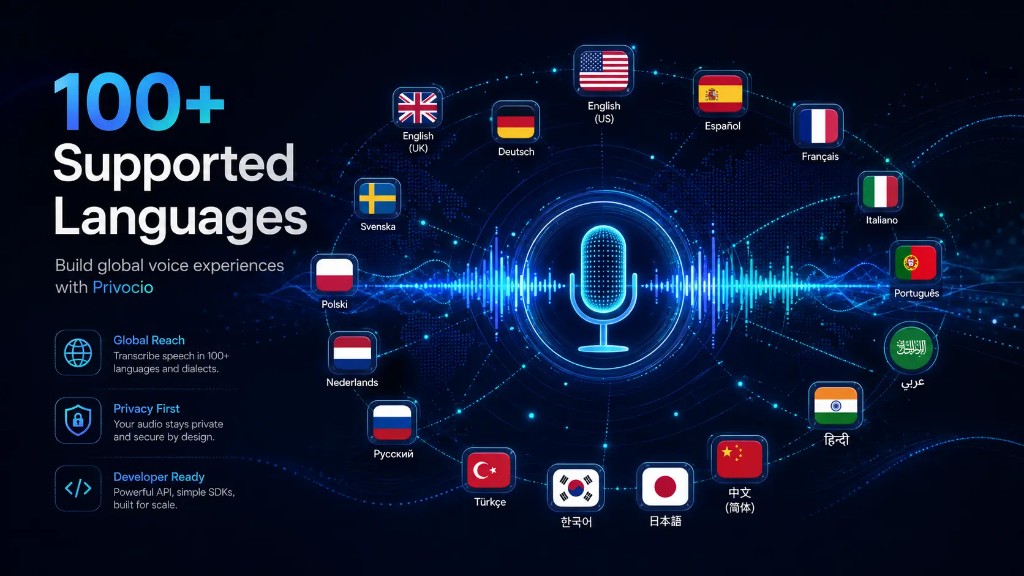
Built for multilingual speech-to-text

Privocio's language support is designed for developers and teams that need practical, production-ready transcription.

You can use it for:

  • transcribing uploaded audio files
  • converting voice notes into text
  • processing meeting recordings
  • powering AI agents with spoken input
  • analyzing support calls
  • building multilingual voice workflows
  • creating internal tools for international teams

Instead of treating multilingual support as an extra feature, Privocio makes it part of the core speech-to-text workflow. Try the free transcription tool or explore pricing when you are ready to scale.

Use cases for global voice to text

Global AI agents

Let users talk to AI agents in their own language.

This makes agents easier to use, especially when users need to explain complex tasks, long instructions, or detailed context.

Typing long instructions is slow. Speaking is faster, more natural, and often gives the AI more context.

Multilingual customer support

Transcribe support calls, voice messages, and customer recordings across different languages.

This helps teams summarize issues, route tickets, detect recurring problems, and create searchable support histories.

Meeting transcription for international teams

Remote teams often work across countries and languages.

A multilingual voice-to-text system can turn meetings, interviews, and internal discussions into usable written records.

Healthcare and legal transcription

In sensitive industries, accurate transcription and privacy are both important.

A privacy-first speech-to-text API can help teams process audio while keeping control over their infrastructure and workflows.

Developer voice features

Add voice input to apps, dashboards, tools, and automations without building speech recognition infrastructure yourself.

Learn more about speech-to-text for AI agents and privacy-first transcription for sensitive workflows.

One API for many languages

The main advantage of a global voice-to-text API is simplicity.

You do not need a different provider for every language. You do not need separate transcription logic for every region. You can build one integration and support many languages through the same API structure.

That makes the developer experience much easier:

  1. Send the audio file.
  2. Pass the language code when you know it.
  3. Receive the transcript.
  4. Use the text in your app, AI agent, database, CRM, or automation workflow.

This is especially useful when your product needs to scale beyond one country. See the API documentation for request examples, or jump to authentication and API keys to get started.

If your app already knows the user's selected language, region, or account setting, you can use that information when sending the transcription request.

Example language codes:

  • English: en
  • German: de
  • Spanish: es
  • French: fr
  • Italian: it
  • Portuguese: pt
  • Arabic: ar
  • Hindi: hi
  • Chinese: zh
  • Japanese: ja

Integrate with the Python speech-to-text API or the JavaScript STT API. For live audio, see streaming transcription.

Better voice experiences for AI agents

AI agents become much more useful when users can speak instead of typing.

A user can explain a task in German, describe a support issue in Spanish, record meeting notes in English, or give a workflow instruction in French.

A multilingual speech-to-text API turns that spoken input into text, so the AI agent can understand it and act on it.

That is why I think voice to text is not just a transcription feature. It is becoming a core part of how people will interact with software. Read more about AI agent voice transcription.

Privacy-first multilingual transcription

Language support is important, but privacy matters just as much.

Voice data can be sensitive. It may contain business information, personal details, customer conversations, medical information, legal discussions, or internal company context.

Privocio is built with a privacy-first approach, so teams can use speech-to-text infrastructure without treating audio data casually. Learn about privacy-first transcription and the private speech-to-text API.

For companies that need more control, self-hosted deployment can also be an important option.

FAQ

What is global voice to text?

Global voice to text means converting spoken audio into written text across many different languages. It allows products to support users from different countries, regions, and language backgrounds through one speech-to-text system.

How many languages does Privocio support?

Privocio supports 100 languages for Speech-to-Text. The language list includes the language name, language code, and STT support status.

Can I use Privocio for multilingual transcription?

Yes. Privocio can be used to transcribe audio in many supported languages, making it useful for global products, AI agents, customer support, meeting tools, and internal workflows.

Is multilingual speech-to-text useful for AI agents?

Yes. AI agents benefit from multilingual speech-to-text because users can speak naturally in their own language instead of typing long prompts.

Should I pass a language code when transcribing audio?

If you know the spoken language, it is a good idea to pass the language code. This makes the transcription request more explicit and can improve consistency.

Is Privocio only for English transcription?

No. Privocio supports 100 speech-to-text languages, so it is suitable for multilingual and international products.

Can I build a global voice product with one API?

Yes. That is the main benefit of a multilingual speech-to-text API. You can build one voice integration and support many languages through the same platform.

Build global voice products with Privocio

Add multilingual speech-to-text to your app, AI agent, chatbot, or internal workflow with one developer-friendly API.