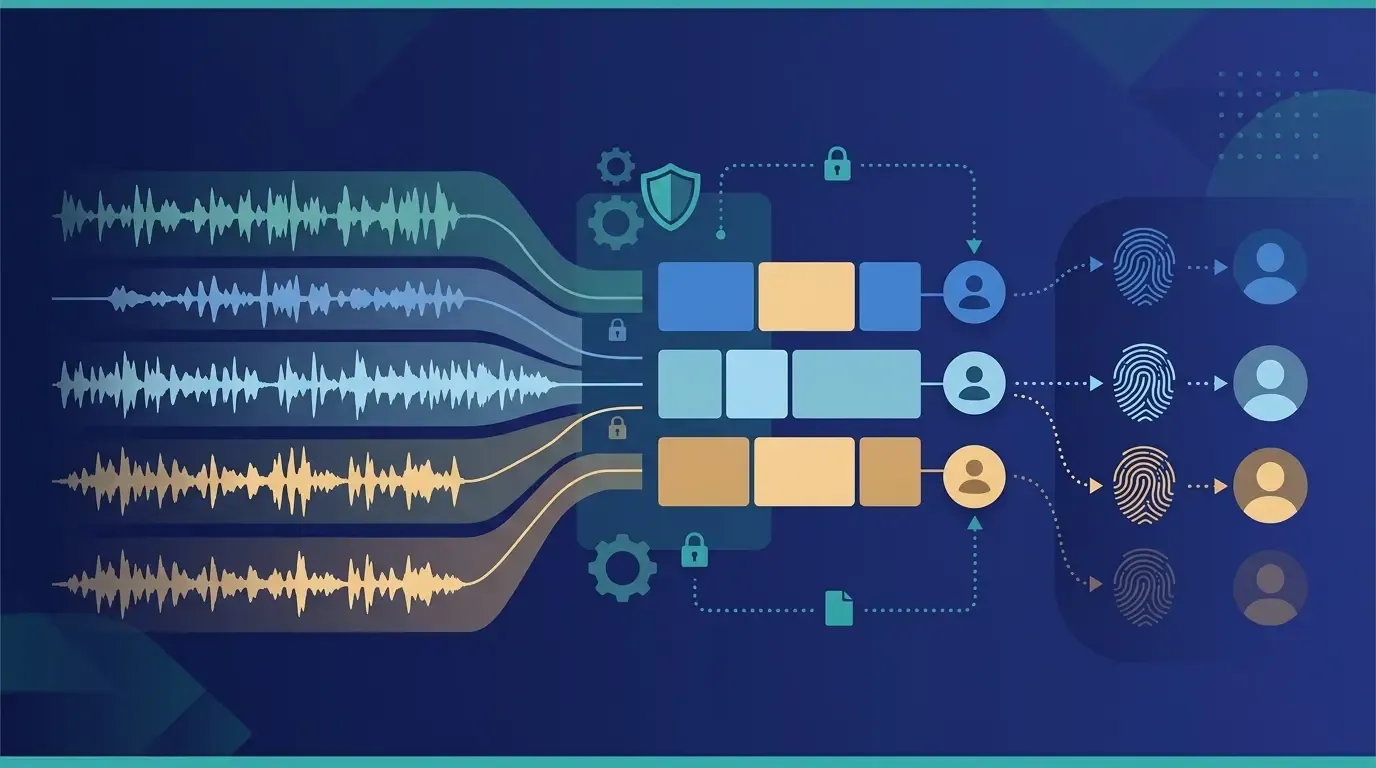
I've watched speaker diarization turn a "private" transcription job into a re-identification risk three times in healthcare deployments. The transcript looked anonymized until someone matched Speaker 2's cadence to a named nurse on the ward schedule. In our complete guide to private speech-to-text, we cover the full privacy stack. This guide focuses on one feature that teams enable by default and regret later: speaker labels.
What Speaker Diarization Adds to a Transcript
Speaker diarization splits one audio stream into segments and assigns each segment a speaker label, usually "Speaker 0," "Speaker 1," and so on. Providers like Deepgram and AssemblyAI expose diarization as a boolean flag or a per-minute add-on. The output helps meeting notes, call analytics, and legal review workflows where you need to know who said what.
For compliance teams, diarization feels like a feature upgrade. For privacy reviewers, it is extra structured metadata that can outlive the audio. I've seen teams treat speaker IDs as harmless because they are not names. That assumption breaks the moment labels correlate with roles, shifts, or room assignments.
When Labels Become Identifiers
Diarization labels become identifiers when an attacker or insider can map them to real people with low effort. Three patterns show up repeatedly in production:
- Small cohort calls: Two speakers on a patient consult almost always map to clinician and patient. Labels do the linking work names would have done.
- Persistent speaker embeddings: Some pipelines store voice embeddings for diarization quality. Those vectors can re-identify a speaker across sessions, similar to biometric data under GDPR Article 9 special-category rules in EU deployments.
- Cross-system joins: Exporting diarized JSON into a CRM or EHR lets you join "Speaker 1" to a user ID with one database query.
| Scenario | Diarization risk | Typical mitigation |
|---|---|---|
| Internal standup (8 people) | Medium: voice + context narrows candidates | Disable diarization; use meeting roster separately |
| HIPAA patient call (2 speakers) | High: labels imply roles | Private STT, no diarization, minimal retention |
| Public podcast (hosts known) | Low: identities already public | Diarization OK for chapter markers |
| Legal deposition (privileged) | High: speaker order is evidence | On-premise STT, air-gapped storage |
Under HIPAA, speaker labels attached to clinical audio can qualify as protected health information when combined with dates, departments, or visit types. I've had compliance officers ask for diarization off by default after an audit flagged exported JSON sitting in a shared analytics bucket for 90 days.
Diarization vs PII Redaction
Post-transcription redaction strips names, phone numbers, and account IDs from text. It does not remove speaker structure. If Speaker 0 always opens the call with protocol language and Speaker 1 asks clinical questions, the role inference survives redaction.
We covered transcript-level redaction limits in PII redaction in speech-to-text pipelines. My rule: if re-identification risk comes from who spoke, not what was said, redaction will not save you. You need architectural controls: disable diarization, shorten retention, or run transcription inside your VPC.
Privocio's Clean and Agent output modes target token efficiency for downstream LLMs. They are not a substitute for turning diarization off when labels are toxic metadata. Check the API parameter on every job. Some SDKs inherit diarization defaults from a team template.
Provider Retention and Training Policies
Diarization often costs extra and may follow different retention rules than base transcription. AWS Transcribe and Google Cloud Speech-to-Text document region-specific logging; you still need to read the diarization addendum in your Business Associate Agreement or Data Processing Agreement.
Questions I ask every vendor before enabling diarization:
- Are speaker embeddings stored, and for how long?
- Can diarization run in a zero-retention mode?
- Does the provider use diarized samples for model training?
Our privacy policy states we never train on customer audio. That stance removes one class of leakage, but your own logs can still hold speaker-labeled JSON. Read zero-retention transcription guarantees before you assume "no training" equals "no labels stored."
Fixed pricing helps here too. Per-minute vendors often bundle diarization as a metered add-on, which encourages teams to leave it on. Our pricing page includes standard transcription without surprise diarization line items on the bill.
When to Disable Diarization
Disable diarization when any of these are true:
- Audio involves fewer than four speakers and roles are sensitive (clinical, legal, HR).
- You cannot explain in a DPIA why speaker labels are necessary.
- Exports will land in data lakes queried by non-clinical staff.
- You are subject to SOC 2 or HIPAA audits and lack a mapping from speaker IDs to access controls.
Keep diarization when speakers are already public (podcasts, webinars) or when analytics genuinely needs turn-taking metrics and you have consent. For agent pipelines, I usually skip diarization and pass a single Clean transcript to the LLM. Turn order rarely matters once you collapse to one speaker stream.
If you need diarization for product features, isolate it: run diarization in a separate job with shorter TTL, store labels in a restricted table, and never merge with CRM IDs in the same row. The API docs show job-level flags so you can split pipelines without forking providers.
Frequently Asked Questions
Does speaker diarization violate HIPAA by itself?
Not automatically, but diarization plus clinical context often creates PHI. I've seen BAAs that allow transcription while staying silent on speaker embeddings. Get explicit language on label retention before you enable diarization in HIPAA-compliant workflows.
Is diarization more private if I use self-hosted Whisper?
Self-hosting removes vendor training risk, but you still generate speaker labels on your disks. The privacy tradeoff moves to your backup and access-control policies, not away. Private infrastructure helps; diarization flags still need a deliberate default-off policy for sensitive audio.
Can I diarize then delete speaker labels afterward?
You can strip labels from exported text, but logs, webhook payloads, and embedding caches may retain them. I treat post-hoc deletion as unreliable unless you prove every pipeline stage drops metadata. Disabling at ingest is simpler to audit.
Do fixed-price APIs charge extra for diarization?
Some per-minute providers add $0.002 to $0.005 per minute for diarization on top of base rates. That nudges teams toward leaving it enabled "because we already pay for it." Fixed plans like Privocio's Go tier at $19 per four weeks remove that metered incentive; you choose diarization based on risk, not marginal cost.
Conclusion: Labels Are Metadata
Speaker diarization is useful engineering, not a free privacy upgrade. Labels become identifiers in small cohorts, in biometric embeddings, and the moment you join them to user records. If your threat model includes re-identification, disable diarization at the API, shorten retention on anything that stores labels, and keep transcription inside a private boundary.
For the full privacy picture, read our complete guide to private speech-to-text. When you are ready to test without diarization defaults baked in, start on the free transcribe tier or review pricing for predictable four-week plans.
Image Credits:
Cover image created with Google Flow Nano Banana.