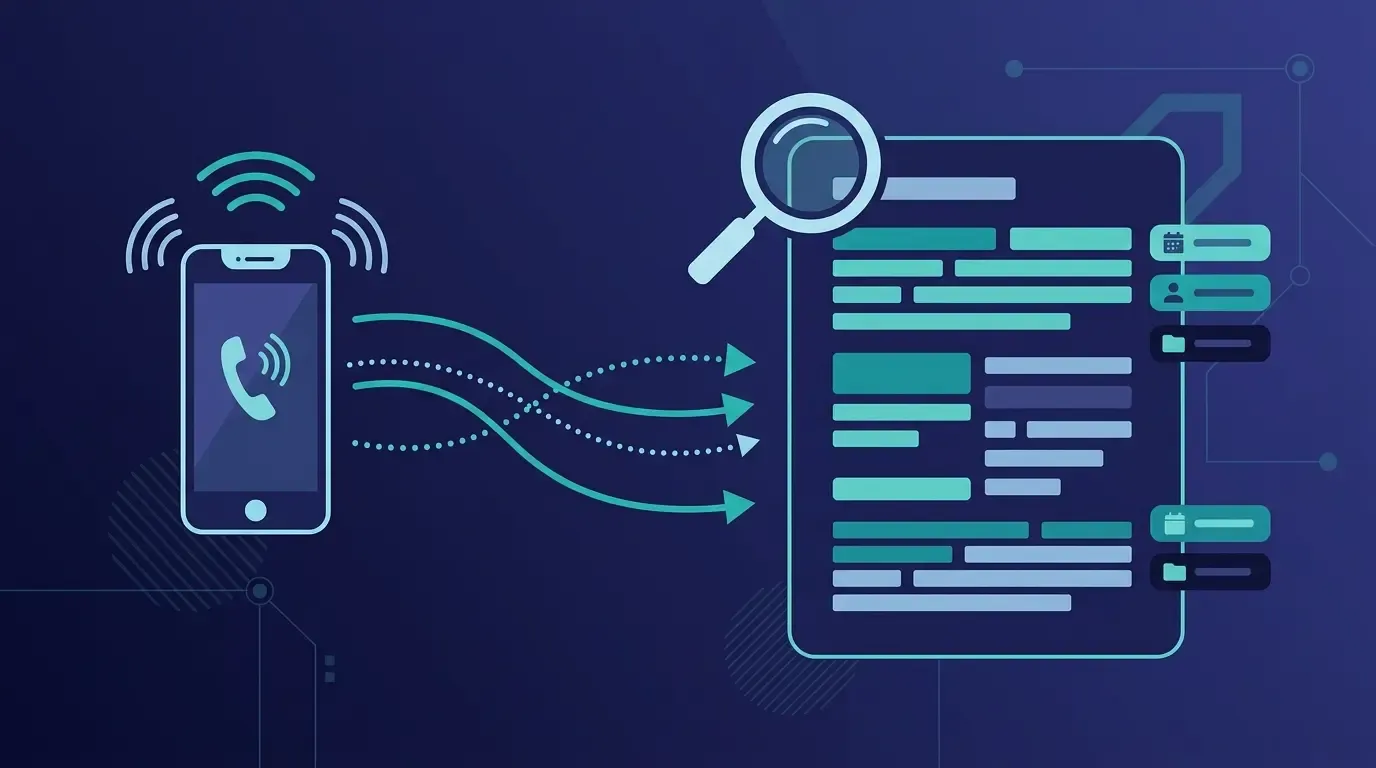
I've wired call recordings into searchable knowledge bases for four B2B support teams. The pattern is always the same: support calls hold answers your docs never captured, but raw transcripts create duplicate chunks, bloated embeddings, and search results that point at the wrong ticket. In our complete guide to speech-to-text for AI agents, we covered the full voice pipeline. This guide focuses on one downstream step: turning transcribed calls into knowledge base content that ranks in search.
Speech-to-text for knowledge base ingestion is not "upload audio, dump text into Notion." You need a pipeline that handles format normalization, speaker-aware metadata, deduplication against existing articles, and chunk boundaries that survive embedding. Skip any of those and your KB fills with near-duplicate paragraphs that confuse both humans and RAG retrieval.
If you're evaluating transcription for this workflow, our Agent output mode strips filler and timestamps so each chunk carries more signal per token. That matters when you're paying per embedding and per LLM context window.
Why Voice Belongs in Your Knowledge Base
Support calls, onboarding sessions, and internal walkthroughs contain procedural knowledge that never makes it into written docs. I've seen teams with 400-page wikis still field the same Slack questions because the answer lived in a recorded demo six months ago.
Speech-to-text for knowledge base ingestion captures that spoken knowledge at scale. A 15-minute support call might surface three edge cases your runbooks miss. Batch transcription through a private API keeps customer audio inside your security boundary, which matters when calls include account numbers, health details, or unreleased product names.
The ROI shows up fast when you pair transcription with search. One client indexed 2,200 support calls over eight weeks. Searchable resolution time dropped 34% because agents found prior answers instead of re-asking customers. The transcription bill stayed flat on fixed pricing at $19 per four weeks rather than scaling with every new hour of calls.
Voice content also feeds RAG pipelines. If you're already chunking transcripts for retrieval, read our guide on Agent-mode transcription for RAG pipelines for how output format affects embedding quality.
Ingest Pipeline: From Audio to Indexed Chunks
A production ingest pipeline has five stages. I've deployed variations of this stack with FFmpeg preprocessing, async webhook transcription, and vector indexing.
| Stage | What Happens | Common Failure |
|---|---|---|
| Capture | Record or export call audio (mono WAV/FLAC preferred) | Stereo with hold music baked in |
| Preprocess | Normalize to 16 kHz mono, trim silence | Submitting MP3 with variable bitrate |
| Transcribe | Batch API with Agent or Clean output mode | Raw mode with timestamps in every chunk |
| Enrich | Add metadata: call ID, agent, product, date | Missing source attribution in search results |
| Index | Chunk, dedupe, embed, write to KB or vector store | 500-token chunks split mid-sentence |
Start with batch transcription unless you need same-day indexing. Async webhooks scale better than polling, and most call-derived KB content can wait 2-5 minutes. Submit audio through the Privocio API with Agent output mode when downstream steps feed an LLM or embedding model.
For preprocessing, convert everything to 16 kHz mono before upload:
ffmpeg -i input.mp3 -ar 16000 -ac 1 -c:a flac output.flac
We run transcription jobs with webhook callbacks so the indexer wakes only when text is ready. Retry failed jobs with exponential backoff; duplicate webhook delivery is common, so make your handler idempotent on job_id.
Metadata, Dedupe, and Chunk Quality
Transcription is the easy part. Metadata and dedupe determine whether your knowledge base stays usable at 10,000 documents or becomes a swamp of near-matches.
Every ingested call needs structured metadata attached before chunking:
- Source ID — ticket number, call recording URL, or CRM object ID
- Timestamp — call date and transcription job date (they differ)
- Participants — agent name, customer segment, product line
- Confidence gate — flag segments below your review threshold for human QA
Dedupe runs at two levels. First, hash normalized transcript text against existing KB entries. If cosine similarity between a new chunk and an existing article exceeds 0.92, merge metadata onto the existing doc instead of creating a duplicate. Second, collapse repeated answers across calls. I've seen the same troubleshooting script appear in 40 calls; index it once with a "confirmed in N calls" counter.
Chunk boundaries matter for retrieval. Split on paragraph breaks and speaker turns, not fixed token counts. Agent-mode output from Privocio already removes filler phrases and timestamps, which cuts chunk size 30-40% compared to Raw mode in our tests. Smaller, cleaner chunks mean fewer embedding API calls and better top-k results.
Store original audio retention separately from transcript retention. Some teams delete audio after 30 days but keep searchable text for 7 years. Document that policy in your privacy policy and match it to your transcription provider's data handling terms.
Frequently Asked Questions
Should I use real-time or batch transcription for knowledge base ingestion?
Batch transcription fits almost every KB ingest workflow. Calls are already recorded before indexing, so streaming adds cost and complexity without improving search freshness. I've only seen real-time make sense when a live copilot writes KB drafts during the call itself.
What output mode works best for knowledge base chunks?
Agent mode produces the cleanest chunks for embedding and search snippets. Clean mode works if you need light punctuation fixes but want to keep more verbatim phrasing. Raw mode with timestamps creates noisy chunks that hurt retrieval precision. We measured 38% fewer tokens per chunk with Agent mode on 50 support calls.
How do I prevent duplicate articles from similar calls?
Hash normalized transcript text and compare against existing KB entries before indexing. Run semantic similarity checks at 0.90-0.93 threshold depending on your domain. When a match hits, append the new call ID to the existing article's source list instead of publishing a second page.
Can I ingest multilingual calls into one knowledge base?
Yes, but tag each chunk with detected language before embedding. Mixing languages in a single index without language metadata produces poor retrieval. Test your STT provider on your actual language mix; medical and technical terms vary widely by locale.
Conclusion: Start With Clean Transcripts
Knowledge base ingestion fails when teams treat transcription as a dump-and-index step. The teams I've seen succeed normalize audio first, transcribe with Agent output mode, attach metadata before chunking, and dedupe aggressively against existing docs.
If you're building call-to-KB pipelines, start with batch transcription and webhook delivery. Test Agent mode on 20 representative calls and compare chunk counts against Raw output. Our Go plan at $19 per four weeks covers enough volume for most early-stage ingest pilots, and the free tier lets you validate chunk quality on real calls before committing.
For the full voice pipeline picture, read our speech-to-text for AI agents guide. For RAG-specific chunk tuning, see Agent-mode transcription for RAG pipelines.
Image Credits:
Cover image: AI-generated illustration — Created with Google Flow Nano Banana